Thoughts on Parashat Toldot
History is undeniably complex. Our traditions teach us to discern between right and wrong, good and evil, but the realities of historical events are often far from black and white. We can confidently assert that Nazi Germany needed to be defeated to restore global peace and stability. However, most historical situations present us with shades of gray. This complexity is why our tradition emphasizes ethics, and notions of right and wrong, good and evil – we have to have tools to navigate the myriad social and historical landscapes we encounter.
The intricate history of the Jewish people reveals a profound narrative of survival, adaptation, and nuanced engagement with other cultures. Our biblical story of Jacob and Esau represents more than a simple genealogical account; it is a complex exploration of interfaith, intercultural and family relationships that have shaped our understanding of community and survival.
Historically, Jewish identity has been both deeply rooted and remarkably adaptable. The Edomites, for instance, underwent significant transformations, ultimately being incorporated into Jewish population through forced conversions during the Hasmonean period. Interestingly, this historical trajectory demonstrates a fascinating trend of religious migration, with more individuals moving towards Judaism than away from it. This phenomenon challenges simplistic narratives of religious isolation and instead reveals a dynamic, evolving spiritual landscape.
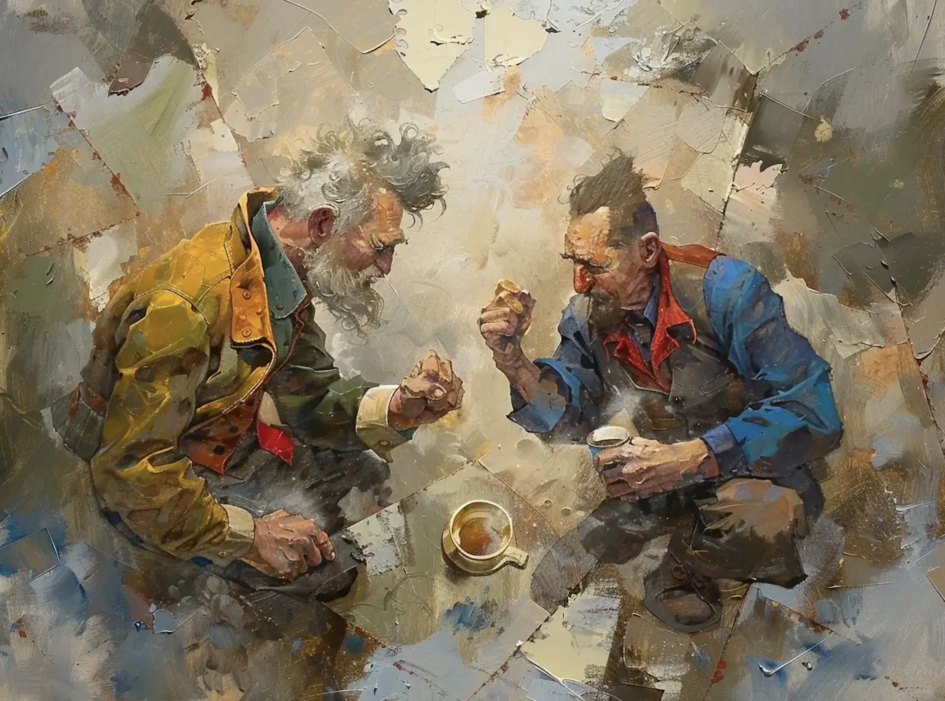
This week’s parasha introduces the origins of a long-standing relationship between two nations: Jacob and Esau, the ancestors of the Israelites and the Edomites.
and יהוה answered her, “Two nations are in your womb, Two separate peoples shall issue from your body; One people shall be mightier than the other, And the older shall serve the younger.” (Genesis 25:23)
The phrase “the older shall serve the younger” can be interpreted in multiple ways. On a surface level, it suggests that the descendants of Esau will be subordinate to the descendants of Jacob. It can also imply the religious supremacy of Judaism over ancient pagan cultures, as The Edomites practiced many pagan cults in , worshiping deities like their national god Qaush but also Baal and Uzzah, until they were all forcibly converted to Judaism by the Hasmoneans and were incorporated into the Jewish population during the 2nd century BC.
Despite this historical backdrop, the Torah instructs us to embrace justice and inclusion. Maimonides exemplified this inclusivity centuries ago by prohibiting discrimination against converts, a stance remarkably progressive for medieval times. His approach underscored a fundamental Jewish principle: genuine spiritual commitment transcends historical boundaries. This perspective is particularly relevant in the Conservative Movement, which has consistently emphasized welcoming those sincerely seeking to join the community.
However, this openness does not imply unconditional acceptance or passive vulnerability. Our tradition teaches a sophisticated approach to interfaith relations that refuses to view the world through a simplistic lens of absolute friends or enemies. Within every religious group, every political party, and every cultural identity, there exist individuals who support or oppose Jewish interests. The critical task is to discern these nuanced relationships with wisdom and strategic thinking.
Isolationism was often imposed upon the Jewish people as a form of systemic marginalization, a circumstance that paradoxically stimulated a strong separatist element within Jewish culture. Yet, our survival has ultimately depended on our ability to build strategic alliances, to understand the complex spectrum of relationships with other nations and religious groups.
The most profound lesson emerges not from a naive pursuit of peace, but instead from a commitment to ethical living. Peace is not an absolute value to be pursued at any cost. Our tradition teaches that ethical action must always take precedence over superficial harmony.
This approach demands patience, long-term strategic thinking, and a willingness to actively engage with people of different identities and faiths. We must prioritize building genuine connections based on mutual respect and shared ethical principles. When potential allies demonstrate support and alignment with our core values we must be prepared to forge meaningful relationships and transcend historical antagonisms.
The ultimate wisdom lies not in seeking peace at any price, but in creating conditions for genuine understanding and mutual respect. Our tradition teaches us that true peace can only emerge from a foundation of justice, ethical behavior, and mutual recognition. Sometimes this means standing firm against evil, even when it appears less comfortable than compromising. Peace is not the absence of conflict, but the presence of justice. Our primary allegiance must be to ethical living, which sometimes requires us to reject superficial harmony. During moments of profound moral challenge – such as the Holocaust – pursuing peace at all costs would have meant capitulation to unspeakable evil. This is why our tradition does not view peace as an absolute value to be achieved through any means, but as a potential outcome of rigorous ethical action.
As we continue to evolve and interact with the broader global community, our tradition offers a powerful framework: engage thoughtfully, maintain ethical integrity, and remain open to genuine connection while never sacrificing our fundamental principles of justice and survival.
Rabbi Mirski

Leave a Reply