Page 17 of 21

Thoughts on parashat Noach.
The fear of the LORD prolongs life, While the years of the wicked will be shortened.
Proverbs 10:27
Immortality is an eternal human longing and its motif is interlaced throughout all religions and cultures of the world, including secular culture. We see this theme everywhere. Literature,

Wszystkich zainteresowanych zapraszam do obejrzenia cyklu moich wykładów/podcastów, który nagrałem tego lata. Temat wydaje się oczywisty i powszechnie znany. W rzeczywistości istnieje w tej kwestii wiele niespodzianek, niuansów i spora ilość rozmaitych interpretacji.
Przykładowo: 1. Nie ma w Biblii przykazania “Nie zabijaj”.

Thoughts on Yom Kippur 5781
During the High Holidays we reflect on the moral actions and decisions we have made over the past year. We wonder if we have harmed our loved ones and the people around us. If we find guilt in ourselves, we ask for forgiveness. When it comes to sin, the interpersonal relationship involved
Refleksja na Jom Kippur 5781.
W okresie Wielkich Świąt, w szczególności zaś w Jom Kipur, zastanawiamy się nad naszymi przewinieniami, moralnymi działaniami oraz moralnymi aspektami decyzji, które podjęliśmy w minionym roku. Zastanawiamy się, czy i

Thoughts on Parashat Haazinu.
I was born and raised in a secular family where certain wisdom and values were instilled in me from early childhood. Among them were values such as education (which is generally considered a carrier of all values), truthfulness, diligence, ambition, being compassionate, sensitiveness

Thoughts and insights for Rosh Hashanah 5781
Religion has the beautifully inherent purpose of helping us gain control and guide us in organizing what is irrational within both our spiritual and practical realms. Maimonides’ view on animal sacrifices, which was performed by the ancient Israelites in the Temple, is
Thoughts on parashat Nitzavim-Vayelech.
Human beings are religious beings. This means we have a natural tendency to develop religion or something that metaphysically deals with the problematic mystery of human existence. Every time human beings want to get rid of religion something else fills this gap and becomes

Thoughts on parashat Ki Teitzei.
Human beings are more prone to be preoccupied with the negative aspects of our existence and tend to ruminate more about unpleasant events. In general, there is not much we can do about this: that’s how our brains have evolved throughout millions of years of evolution – this

Thoughts on Parashat Shoftim.
Is it possible to eliminate crime completely? How about at least eliminating the worse crime, murder? It probably is possible. Here is a scenario: We lock all the people in individual prison cells and we construct our societies that way. It would require three social castes: prisoners
Thoughts of Parashat Re’eh
How do you know if those you think are wicked are really wicked? Aleksandr Solzhenitsyn said that there is no absolutely evil person in the world and no one who is absolutely good either (paraphrasing his famous saying which I quoted in my drasha a few weeks ago). Similarly, the
About Rabbi Cantor Menachem Mirski, Ph.D.
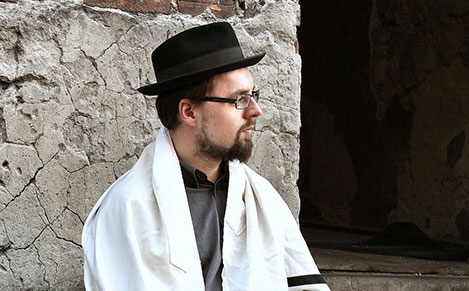
Rabbi Menachem Mirski was born and raised in Poland, where he was a musician, a scholar, and active in helping revive the Jewish community in Poland. While still in Poland, he trained and worked as a hazzan, leading weekly services. He is an accomplished musician, performing in the klezmer scene in Europe and America for well over a decade. At the same time, he earned a Ph.D. in philosophy from the Maria Curie-Sklodowska University in Lublin, Poland. His dissertation was on Jewish Theological Responses to the Holocaust.
Rabbi Mirski’s scholarly pursuits inspire his congregation to delve deeper into Jewish religious concepts and their faith. His passion lies in unlocking the timeless wisdom of Torah and traditional rabbinic teachings to tackle today’s cultural, philosophical, and social challenges. With his gentle and welcoming demeanor, Rabbi Mirski embodies a deep commitment to fostering a tight-knit community and nurturing genuine bonds.
Contact:
Menachem@MenachemMirski.com
(424) 522-9438
Share Your Feedback
Instagram for Temple Beth Shalom
Menachem Mirski YouTube Channel
Donate via PayPal:
Click Here to Donate

Donate via Venmo:
pmirski@aju.edu
Donate via Zelle:
4245229438